NCARB PDD測試 - PDD考試內容
Wiki Article
此外,這些VCESoft PDD考試題庫的部分內容現在是免費的:https://drive.google.com/open?id=1oNpLDuilwtKT9EiNeL0oOsvo6FtBZEpf
選擇使用VCESoft提供的產品,你踏上了IT行業巔峰的第一步,離你的夢想更近了一步。VCESoft為你提供的測試資料不僅能幫你通過NCARB PDD認證考試和鞏固你的專業知識,而且還能給你你提供一年的免費更新服務。
NCARB PDD 考試大綱:
| 主題 | 簡介 |
|---|---|
| 主題 1 |
|
| 主題 2 |
|
| 主題 3 |
|
| 主題 4 |
|
| 主題 5 |
|
最新PDD題庫的PDF版是廣大考生必選對象-是通過 PDD 考試的保障
近來,NCARB的認證考試越來越受大家的歡迎。NCARB的認證資格也變得越來越重要。作為被 IT行業廣泛認可的考試,PDD認證考試是NCARB中最重要的考試之一。取得了這個考試的認證資格,你就可以獲得很多的利益。如果你也想參加這個考試的話,VCESoft的PDD考古題是你準備考試的時候不能缺少的工具。因为这是PDD考试的最优秀的参考资料。
最新的 Architect Registration Examination PDD 免費考試真題 (Q33-Q38):
問題 #33
Why is the vertical surface of a dry-stacked stone wall often battered into the retained material?
- A. Increased cohesion between individual stones that make up the wall
- B. Increased impermeability that reduces equivalent fluid pressure
- C. Increased resistance to soil thrust
- D. Increased resistance to surface erosion of the wall
答案:C
解題說明:
A battered (leaning back) face on a dry-stacked retaining wall improves stability against lateral earth pressure by shifting the wall's resultant closer to/within the middle third of the base, increasing frictional resistance and reducing overturning. It does not significantly change permeability (C) or directly increase cohesion between stones (D), and erosion resistance (B) is secondary compared to stability.
PDD References: Site & foundation systems-retaining wall behavior, active/passive earth pressures; IBC
/Geotechnical fundamentals; CSI Div. 32 site improvements.
問題 #34
The single-line diagram for the electrical distribution system shown is for a multi-family project.
Click in the box on the single-line diagram where the transformer is located.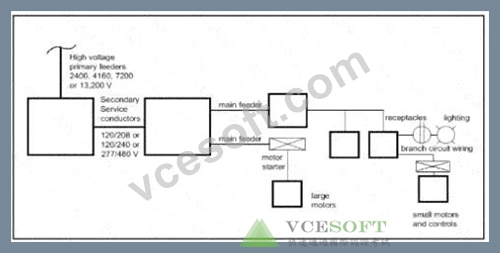
答案:
解題說明: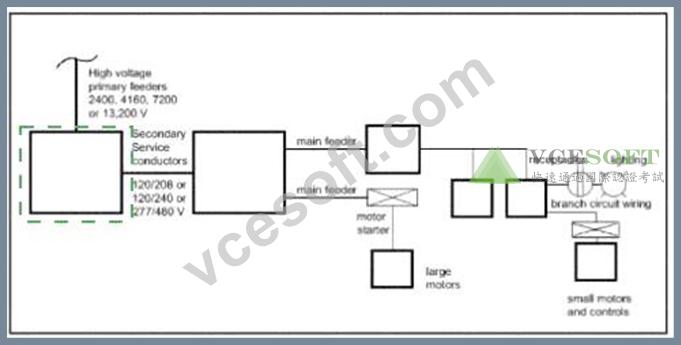
Explanation: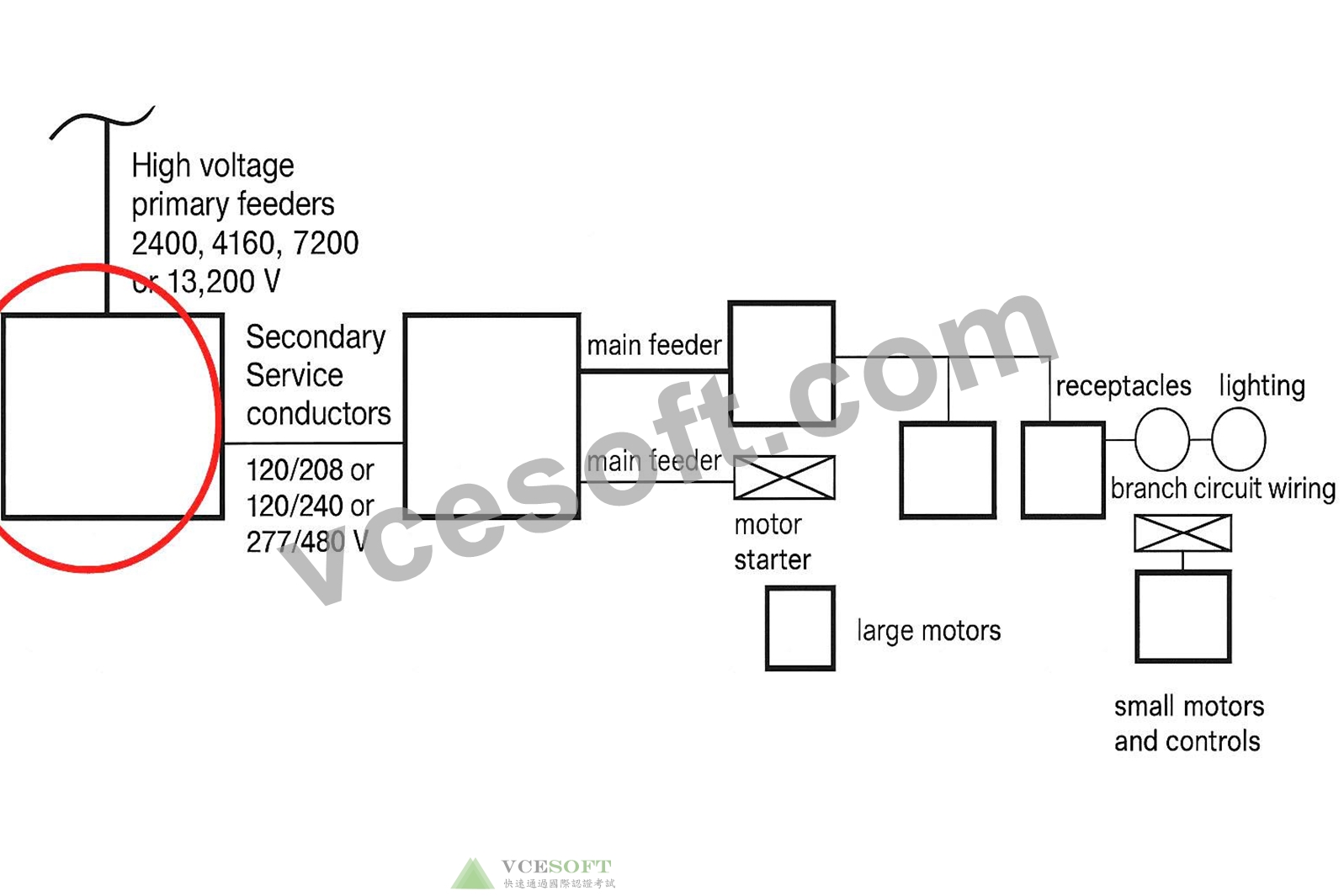
The transformer is located in the first large box after the high-voltage primary feeders and before the secondary service conductors on the left side of the diagram.
Step-by-Step Reasoning
1. Understanding the diagram flow:
* The leftmost symbol represents high-voltage primary feeders from the utility (2,400V, 4,160V, 7,200 V, or 13,200V).
* Immediately after that, there is a large box labeled "Secondary Service conductors" with standard building service voltages (120/208, 120/240, 277/480 V).
* To get from primary (medium/high) voltage to these usable secondary voltages, you must step down the voltage - and that is done by a transformer.
2. Transformer location in electrical distribution:
* Transformers are always placed between the incoming primary service and the secondary distribution system in building diagrams.
* In this drawing, the transformer is symbolized by the first large square/rectangular box after the high- voltage primary feeders.
3. Why not any other box?
* The following boxes and lines after this first step are feeders, panels, and motor starters - they operate at secondary voltage.
* Only the transformer connects the utility high-voltage system to the building's lower-voltage system.
NCARB ARE 5.0 PDD References:
* Content Area: Electrical Systems - Service Entrance and Distribution
* Source References:
* MEEB (Mechanical and Electrical Equipment for Buildings) - Chapter on Transformers & Electrical Service
* NEC (National Electrical Code) Article 450 - Transformer Installation and Use
* Architectural Graphic Standards - Single-Line Diagrams for Electrical Distribution Key Point:
In building electrical distribution, the transformer is always between the high-voltage primary service and the secondary service conductors to step down voltage to a usable level for building loads.
問題 #35
Fire and smoke control requirements for air ducts include which of the following? Check the three that apply.
- A. Variable-volume smoke controls
- B. Smoke damper
- C. Fire damper
- D. Balancing damper
- E. Air-handler shut-down sensors
- F. Smoke barrier
答案:B,C,E
解題說明:
HVAC duct penetrations through fire/smoke rated assemblies require listed dampers and control/sensing to limit spread of flame and smoke.
Fire dampers (D) close on heat to maintain the fire-resistance rating of penetrated assemblies.
Smoke dampers (A) limit smoke migration in smoke partitions/barriers and in smoke control systems.
Air-handler shut-down sensors (F) (e.g., duct smoke detectors interfaced with the FA system) stop fans to prevent smoke distribution.
Not required: Balancing dampers (B) (for airflow only); Smoke barrier (C) (a wall/assembly requirement, not a duct device); Variable-volume smoke controls (E) (project-specific engineering, not a base requirement).
PDD refs: IBC Ch. 7 & 9; IMC §§607 (dampers) & 606 (smoke detection in ducts); ARE 5.0 PDD-MEP/fire protection integration.
問題 #36
An architect is designing a sub-surface drainage system that outfalls into a site retention pond. The recommended shape, size, and slope of the drainage lines need to be determined for primarily which of the following purposes?
- A. To increase the desired velocity
- B. To obtain the desired velocity
- C. To maximize the desired flow
- D. To minimize the desired flow
答案:B
解題說明:
In subsurface drainage system design:
The shape, size, and slope of drainage lines are selected primarily to achieve a desired flow velocity that prevents sedimentation and clogging but does not cause erosion.
Minimizing or maximizing flow is not the goal; the system must convey the design flow efficiently.
Velocity must be balanced - too low leads to sediment build-up; too high causes pipe damage.
Reference:
NCARB ARE 5.0 Review Manual, Site Design and Civil Engineering chapter
Drainage design principles from civil engineering manuals and EPA stormwater guidelines
問題 #37
Temporary shoring of a masonry wall should remain in place until what point?
- A. Foundations are backfilled
- B. Lateral bracing connections are complete
- C. Mortar joints are struck
- D. Horizontal reinforcing is installed
答案:B
解題說明:
(PDD) Study Guide References:
Temporary shoring in masonry construction supports walls until they gain sufficient stability. It should remain in place until:
The wall is laterally braced or tied back to a stable structure to resist wind and other lateral loads.
Mortar may have hardened but shoring removal depends on the overall stability.
Horizontal reinforcing and backfilling provide some support but do not replace lateral bracing.
Thus, temporary shoring should remain until all lateral bracing connections are complete, ensuring the wall's stability.
Reference:
NCARB ARE 5.0 Review Manual, Construction Methods chapter
Masonry construction standards and OSHA guidelines on temporary shoring
問題 #38
......
VCESoft的經驗豐富的專家團隊開發出了針對NCARB PDD 認證考試的有效的培訓計畫,很適合參加NCARB PDD 認證考試的考生。VCESoft為你提供的都是高品質的產品,可以讓你參加NCARB PDD 認證考試之前做模擬考試,可以為你參加考試做最好的準備。
PDD考試內容: https://www.vcesoft.com/PDD-pdf.html
- 最新的PDD測試 - NCARB ARE 5.0 Project Development and Documentation Exam - 有效PDD考試內容 ♻ 來自網站「 www.vcesoft.com 」打開並搜索[ PDD ]免費下載新版PDD題庫上線
- PDD考試 ???? 最新PDD題庫資訊 ???? PDD考題免費下載 ???? 在▛ www.newdumpspdf.com ▟網站上查找➤ PDD ⮘的最新題庫最新PDD題庫資訊
- PDD權威認證 ???? PDD題庫最新資訊 ???? PDD題庫下載 ???? ⇛ www.vcesoft.com ⇚最新▷ PDD ◁問題集合新版PDD題庫
- PDD考題套裝 ???? PDD考試資訊 ???? PDD題庫分享 ❤️ 開啟「 www.newdumpspdf.com 」輸入「 PDD 」並獲取免費下載PDD考題免費下載
- PDD考題資源 ???? PDD熱門證照 ???? PDD權威認證 ???? 立即在「 tw.fast2test.com 」上搜尋⇛ PDD ⇚並免費下載PDD最新題庫資源
- 100%合格率PDD測試&資格考試領導者和精心準備的NCARB ARE 5.0 Project Development and Documentation Exam ???? 立即在➥ www.newdumpspdf.com ????上搜尋▷ PDD ◁並免費下載PDD考試資訊
- 免費下載PDD考題 ???? PDD最新題庫資源 ???? PDD題庫分享 ???? ➡ tw.fast2test.com ️⬅️網站搜索⮆ PDD ⮄並免費下載PDD題庫下載
- 最有效的PDD測試,免費下載PDD考試題庫幫助妳通過PDD考試 ???? 免費下載▷ PDD ◁只需在✔ www.newdumpspdf.com ️✔️上搜索PDD認證考試解析
- PDD題庫最新資訊 ✔ PDD考試 ???? 新版PDD題庫上線 ???? 到▶ tw.fast2test.com ◀搜索【 PDD 】輕鬆取得免費下載PDD考試
- PDD套裝 ???? 新版PDD題庫上線 ???? PDD試題 ???? 複製網址☀ www.newdumpspdf.com ️☀️打開並搜索⏩ PDD ⏪免費下載PDD熱門考古題
- 新版PDD題庫 ⭐ PDD試題 ???? 免費下載PDD考題 ???? 立即在✔ www.newdumpspdf.com ️✔️上搜尋➥ PDD ????並免費下載PDD考試
- finnianeyfz207183.blog4youth.com, enrollbookmarks.com, bookmarkingace.com, declanfeup955460.ssnblog.com, guideyoursocial.com, zubairtrwg828270.creacionblog.com, lewisngdd882684.wikiparticularization.com, umarnamz255891.webbuzzfeed.com, gretasynj087882.59bloggers.com, craigbtyc966122.spintheblog.com, Disposable vapes
此外,這些VCESoft PDD考試題庫的部分內容現在是免費的:https://drive.google.com/open?id=1oNpLDuilwtKT9EiNeL0oOsvo6FtBZEpf
Report this wiki page